
 Russian
In the current era where logistics warehousing and manufacturing are accelerating their transition to electricization, electric forklifts have become the main force for on-site material handling. However, "how long can it run on a single charge?" remains a persistent concern for equipment managers. Battery depletion during the afternoon, insufficient power before shift changes, and the impact of charging queue on the delivery schedule - these operational disruptions caused by range anxiety are becoming a hidden bottleneck for improving enterprise efficiency.
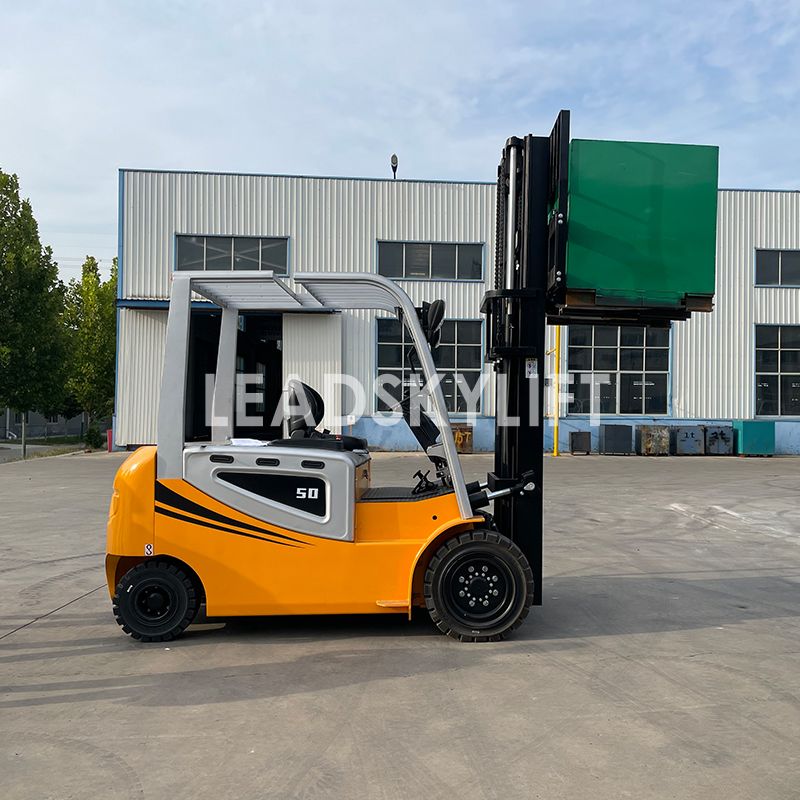
Recently, we conducted a full-day real-world endurance test on a new generation of domestically-made lithium battery-powered forklift (3-ton counterbalanced type), aiming to verify a key proposition: Can an electric forklift truly sustain a complete 8-hour work shift?
I. Actual Test: 8-hour continuous transportation, remaining battery power
This test was conducted at a comprehensive logistics distribution center in the Yangtze River Delta region, simulating a typical 8-hour continuous operation scenario during the day.
Tested vehicle model: 3-ton lithium battery powered counterbalanced electric forklift
Test conditions setting:
Type of goods: Palletized paper boxes and plastic storage boxes
Single-load capacity: Average 2.5 tons (load utilization rate approximately 83%)
Work route: Unloading area → Temporary storage area → High-level shelving area → Loading area. One round trip is approximately 120 meters.
Number of cycles per hour: 12 - 15 times
Surface condition: epoxy floor + outdoor cement pavement mixture
Measured results record:
Time Period Work Content Remaining Battery Capacity (SOC)
08:00 Full charge for departure 100%
10:00 Continuous operation for 2 hours 76%
12:00 No power interruption during lunch break, low-frequency operation 60%
14:00 High-density stacking operation 41%
16:00 Last 2 hours of loading operation 24%
Key Conclusion: After 8 hours of continuous operation, the vehicle still has 24% remaining battery capacity. There was no power decline or speed limit protection throughout the process. Through calculation, the theoretical range under full charge can reach more than 10.5 hours, completely breaking the conventional perception that "electric forklifts run out of power in just half a day".
II. Why Can It Run for So Long? Analysis of Four Core Technologies
1. Intelligent BMS Dynamic Balance Management
The new generation of electric forklifts typically come equipped with an intelligent BMS (Battery Management System) lithium battery management system. The core breakthrough lies in the dynamic balance technology. The system can adjust the voltage differences between battery cells in real time during charging and discharging, avoiding the "bucket effect" - that is, a single cell running out prematurely causing the entire battery pack to fail. The actual test results show that after 300 charge-discharge cycles, the capacity degradation rate of the battery pack is less than 4%.
2. Dual-motor independent drive architecture
Unlike the traditional "single-motor drive + mechanical transmission" structure, the new generation of vehicles adopts a completely independent design for the walking motor and the oil pump motor:
Steering motor: Only responsible for steering. When the load is light or the speed is constant, it automatically reduces the output power.
Oil pump motor: Starts and stops as needed. When there is no lifting action, it automatically enters standby mode, with standby power consumption of only 50W.
This design reduces the overall vehicle energy consumption by approximately 15-20% compared to the previous generation, making it particularly suitable for intermittent operation scenarios.
3. Regenerative Braking + Potential Energy Recovery System
Every time the vehicle brakes or the forks descend, there is actually recoverable energy. Modern electric forklifts are typically equipped with regenerative braking systems and potential energy recovery modules:
When decelerating or going downhill, the walking motor generates electricity in reverse, which is then used to recharge the battery.
When the forks are lowering with load, the hydraulic oil drives the oil pump motor to reverse through the regeneration circuit, thereby generating electrical energy as well.
Overall calculation shows that the electricity recovered during a single day's operation accounts for approximately 10-15% of the total consumption, which is equivalent to "free" gaining nearly 1 hour of battery life each day.
4. AI Learning-based Energy Scheduling Algorithm
This is a relatively new software innovation in the field of electric forklifts in recent years. The system autonomously learns the operating habits of the driver and the characteristics of the working environment based on the accumulated operation data:
Identify frequently accelerating sections → Optimize torque response in advance, reducing energy consumption during sudden acceleration;
Identify nodes that have been in standby mode for a long time → Automatically enter deep sleep mode, retaining only basic communication capabilities;
Identify the overloaded climbing scenario → Prioritize allocating power to the walking motor to prevent the oil pump from seizing up on power.
After approximately 2 weeks of adaptive learning, the overall vehicle energy efficiency can be further improved by 5-8%.
III. Not only long battery life: These configurations also add points
Apart from battery life, the new generation of lithium battery electric forklifts excel in multiple aspects:
✅ Automatic parking on slopes: When parking, the electromagnetic braking system automatically activates. The vehicle does not roll away when starting on the slope, ensuring safety and reliability.
✅ Large-sized LCD instrument panel: The battery level, temperature, fault codes, and maintenance reminders are all clearly displayed. It supports switching between Chinese and English.
✅ Seat Disengagement Safety Protection (Optional): When the driver leaves the seat, the forklift lowering function automatically locks to prevent accidental operation.
✅ Low-noise design: Optimized hydraulic system + Motor sound insulation treatment, with operational noise below 65 decibels.
✅ Expansion capability of accessories: Optional side loader, distance adjuster, paper roll holder, soft packaging holder, etc., suitable for different types of goods.
✅ One-year full vehicle warranty: 12-month unlimited-hour warranty after delivery, covering the three-electricity systems (battery, motor, and electronic control), with nationwide warranty coverage.
IV. Applicable Scenarios: Who is the Best Fit for This Vehicle?
Based on the actual performance, the 3-ton lithium battery electric forklift is particularly suitable for the following scenarios:
Logistics Distribution Center: Frequent, short-distance pallet handling, with no downtime for 8 hours;
Manufacturing workshop: Material distribution beside the production line, intermittent operation with long idle time;
Cold storage operation: Lithium batteries have superior low-temperature performance compared to lead-acid batteries. They can still be charged and discharged normally at -20℃.
Shifted-shift enterprises: With the support of fast charging technology (fully charged to 80% in 1.5 hours), power can be replenished during lunch breaks, enabling drivers to stop at their vehicles without having to keep moving.
V. Conclusion: The worry about battery life is over. It's time to move on.
Electric forklifts are not bad; rather, they were not good in the past.
The new generation of lithium battery-powered forklifts, through four core technologies including BMS dynamic balancing, dual-motor independent drive, energy recovery, and AI energy consumption algorithm, have extended the actual working range of 3-ton electric forklifts to over 8 hours. This means: A regular day driver can work from morning to night without having to find a charging station in the middle, without worrying about insufficient power in the afternoon, and without competing with night shift colleagues for charging spots.
Range anxiety, which used to be a reason for purchasing electric forklifts, is no longer a concern with the new generation of lithium-ion forklifts.